
Introduction
The next several chapters discuss methods for simulating the genealogy of a sample. This branch of population genetics is called coalescent theory and it provides an explicit generative model for data. Typically, this model is a null model not involving selection, but this assumption can be relaxed to some extent.
These chapters should accompany texts discussing the relevant theory. Examples appropriate for graduate-level courses are:
Wakeley’s excellent book. [Wak08].
Hudson’s seminal 1990 review [Hud90]
Nordborg’s chapter in Handbook of Statistical Genetics. [Nor04]
Rosenberg and Nordborg’s review. [RN02]
Factors of two
A constant source of confusion to people learning about coalescent models has to do with time scaling. As discussed in the references above, time is measured in continuous units with respect to the (effective) population size. Thus, we may say that an event occurred \(\tau = \frac{g}{2N_e}\) time units ago, where \(g\) is the number of generations. Here, \(\tau\) is a measure of time in units of \(2N_e\) generations.
Sadly, factors of two are casually ignored, omitted, or forgotten about entirely when explaining the meaning of analytical expressions or how various software tools work.
To the best of my ability, all time units presented here will be in units of \(2N_e\) generations.
This scaling differs from how Hudson’s ms program [Hud02] treats time units, which itself differs from Kelleher et al.’s msprime [KEM16].
We will make note of differences in scaling as necessary.
Representing trees
This tree is a random sample from the Kingman coalescent.
This tree shows the ancestral history of a present-day sample of \(n = 5\) randomly-chosen samples.
Each node on the tree (small black circles) are labelled with id: (time, parent id).
The id is an index that uniquely identifies each node.
This tree has the following properties:
Our present-day samples have
idvalues from \([0, n)\).Each present-day node has a time of 0.
Time increases into the past.
Time is measured in units of \(2N_e\) generations. Note: the simulator used scales time in units of \(N_e\) generations. The values have been adjusted.
There are a total of \(2n - 1\) nodes.
The root node has
id8. The parentidof this node has a value of -1, which we interpret asNULL. ThisNULLindicates that there is no parent, thus indicating that this is a root node.
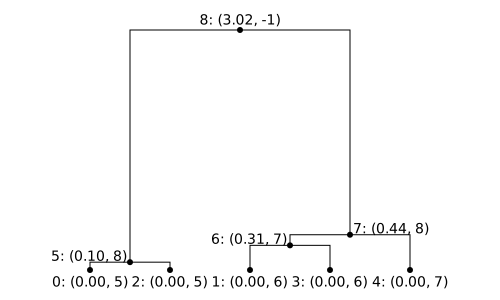
For reasons of computational efficiency, it is convenient to represent these tree structures as a collection of arrays. These collections describe a tree in a table-like format:
| parent | time | |
|---|---|---|
| node | ||
| 0 | 5 | 0.000000 |
| 1 | 6 | 0.000000 |
| 2 | 5 | 0.000000 |
| 3 | 6 | 0.000000 |
| 4 | 7 | 0.000000 |
| 5 | 8 | 0.098546 |
| 6 | 7 | 0.310345 |
| 7 | 8 | 0.443811 |
| 8 | -1 | 3.020761 |
For a given sample size, we need arrays of length \(2n - 1\).
We use the id of a node to index these arrays, allowing efficient lookup of a node’s parent or time.
These indexed tables are the basis for efficient algorithms on the trees.
The table shown above allows convenient traversal from any node back to the root.
For example, consider the node with id 1.
From the above table, that node’s parent is 6.
The parent of 6 is 7.
The parent of 7 is 8, which is the root.
We can write this algorithm as follows:
import typing

def path_to_root(node: int, tree: typing.List[int]) -> typing.List[int]:
    u = tree[node];
    path = []
    while u != -1:
        path.append(u)
        u = tree[u]
    return path
Applying it to node 1 gives:
[6, 7, 8]
Linked lists
This representation of a tree is a form of a singly-linked list.
Each element of the tree refers to its parent, which is the next element in the list.
Thus, we can enter the tree at any point and follow this list until we hit a NULL value.
We can do quite a lot with this simple representation of a tree. In practice, current methods use multiply-linked lists to enable algorithms to efficiently traverse sub-trees.